An exotic British duo of teenagers, when put in an Indian environment, realize so many different tenets to life that get lost in constant abundance. They regain it in almost an obstructed simplicity of the Indian culture.
Note how after so many days of constant patronage by the foster mother, the teen finally opens up about family issues. Talking about his demised nanny makes him tear up and puts in him a bead of striking ambition for the first time.
Perhaps it is only when we sincerely acknowledge our loss and the hurt that comes with it, and we accept that life and its instruments have the ununderminable capacity to put us down, we rise for the better and desire to send our ambition out into an awaiting world.
I love how Charolette took her first photograph once they went to the family farm, and she enjoyed the moment despite her own issues with the situation. And she wasted a huge part of her stay due to her adamance and rigidity.
Rebellion takes away a lot from a journey that could've meant a lot for you. Makes us all reflect about our situations and our decisions. Why do we always resist the air of change around us? Why do we always give the upper hand to ego?
Arguably the most archetypal image of Mahabharata. Describes the crux of Mahabharata. An unwilling warrior king charioteered by an unbiased, divine counsel and driven by machinistic animals of war -- white chariot horses -- towards destiny, through the blur of dark, irrelevant corpses of silent allegiance, fragmented armour, and destroyed machinery. Thematic of "Duty".
Many similar versions exist and the exact author was almost a headache to find. It seems to be Pariksit Dasa. Many of his other realist works have appeared on the covers of ISKCON books.
Epics in the Classical age (Greek, Indian, etc.) were somehow very transparent, moral-bearing and Herculean. There was a sense of direction and achievement very detached from shorthand material gains. Somehow the image of god that men longed to attain sight of was not one of fear and misanthropy but of obligation and aspiration. Religions came up, teaching different 'cheats' to attain forgiveness, and continuing this delusive trade all the way to the supposed human afterlife.
Also, strange things happened to the Indian race following that. A race of cultured, educated, moral, obligated men suddenly left all their ego and gave in to lust, allegiance and chaos. Probably all our famines made us like this. All our lack of resources and our mismanagement. It will take time to reach the zenith of abudance laden creation once again.
This producer and the strikingly good frestylers make me feel like there should be a genre of music like this in Bengali. Fuad has gone to some length to promulgate that, with his hip-hop beats. But I think a problem with the Bengali language is that it is too polite, rounded and not abrasive enough for an aggressive genre like hip-hop, trap, rap, etc. Further there is deep social stigma about objectionable lyrics -- something the Hindi language freed itself of with nightclub culture, Westernization and the genius of Honey Singh. If there was an active community in the Bengali speaking world such as the Punjabi's, maybe we would have our own collection of hip-hop as well.
Watch how this man leaves the attachment of home and family to fulfill an ultimate spiritual quest of visiting his homeland that lies separated by governments, borderwalls and artillery. Despite his wife's clear discomfort, he realizes that he must go. And he does. And it remains a warm experience for him, at least for the documented part.
It ends with a hope to reunite the two countries together. I find that very interesting. It aligns with my vision. Sooner or later, each and every individual, every state will realise that it is your neighbours and not your affiliation that stands by you in times of need and crisis. The sooner this realization comes, the faster is the advent of progress, tolerance and harmony inside a country. No community—Indian, Pakistani, Bangladeshi, Nepali, whichever it may be situated in—can sustain development without having great moral clarity in their thoughts and actions. When you denounce somebody based on some characteristic of theirs that has nothing to do with you, nothing against you, then you cultivate a false sense of supremacy that can never help you prosper in the longer run.
There can hardly be an overstatement about how beautifully the minimalistic, droning, self-accompanied banjo of Balochistan, Pakistan, fits in with its graceful surroundings.
If only we were not shredded by wars and held apart by barbed wires, we would have so many tranquil valleys and so much azure sky to be kissed by the sight of. It almost takes divine intervention to separate us.
This screams liberation. The amazing thing about Black Gospel music is how down to earth it can be. Blacks have singlehandedly brought forth unpretending realism in modern music—from rap to gospel. This is in part a right that they have exclusively earnt through their century-long struggle for survival, then equality, and then social normalization. One cannot prohibit the Black person from writing realist lyrics on the accusation of brashness, because the Black person has seen the limits of White animalism hidden under the veil of sanctimony.
Anyhow, I like how the song grooves. Not even sure if the song is about getting over a lost lover, or over a difficult phase in life in general.
I like this version because of its circumstantial depth. Here is a woman in her seventies, singing like a freebird a song of youthful discovery of love, in a country where all negative presuppositions are shunned and sincerity is not feared, and strength does not have to be the lack of feeling.
I have always loved Obama's integrity and expression of culture. When he tears up in the song, I tear up a little as well, and when Franklin drops her overcoat and crescendoes a climactic single note, my throat feels swollen.
How can man feel so powerful when circumstances support, goodwills agree and intents converge? Where does the objective hindrance that stood tall for so many days disappear suddenly?
Listening to his hocketing on a "one note bamboo flute". It's a musical technique apparently the Pygmies use. Anything played in this technique has a recurrent nature centered around the note of the bamboo flute. It doesn't need to be the root note though that the bamboo flute plays -- clearly, he's playing the bamboo flute as a fifth.,
This is an epic of epics. It is a rare creation of man where he truly identifies his true enemy—a limited resource. In this case, time. It is not a story of man against man; it is a story of man against the machinery of time. It is a distilled look into the true, objective, uncluttered future, which ideally should only be populated with our desire to allocate limited energies and resources to that which is most important of all things—survival and knowledgeability.
An amazing piece about the passion that encapsulates the process of writing and of coming up with material for writing. Describes an authoritative, transparent, uncompromising and supremely true stance on what writing should be. It should be nothing short of heartfelt. Bukowski didn't live a life anything short of heartfelt -- and that does not go to say that he was always feeling and compassionate towards his surroundings, and even to himself. He was a waste for just as long as he wanted to be, and he was a devoted one at that.
An enchanting narrative of a blind man journeying in a train that apparently packs nothing out of the ordinary and yet keeps you hooked to his conversations with a lady copassenger, that continue taking gently daring turns at every interchange. Explores the desire of a man to want to find beauty he is forbidden from just so that he can appeal to his moment's musing. Ends with a shocker that keeps you regurgitating the story over and over and thinking if anything could've gone a little better, a little more ideallic.
The first novel of elusive love I ever read will always have a special place in my heart. The amount of clandestinity in it towards the end was almost illegal and jarring for me as a young teen trying to glide my way through class 6. 'How can he come to like a friend's mother?', was the most sustained inquisition this daunting book left on my mind. I hoped to find an answer someday.
Listening to Robert Glasper makes me feel like I am witnessing the reincarnation of Ahmad Jamal on the keys. Starkingly similar chord changes, tonal directions, mood of playing and virtuoso.
I think the drummer is like Yussef Dayes; I'm not sure as I heard Yussef quite a while ago and not much more than his accuracy resonated a lot with me. Especially when compositions are original, it is hard to make a mark unless the composition is actually milestone in nature.
On a separate note, I may have listened to too many versions of Stella by Starlight.
Change my mind but Sylvain Luc is a far more sophisticated and gifted improviser, soloist, accompanist and a better guitarist in general than Birelli Lagrene. Such tasteful chordal choices! His solo in particular is so well composed and structured that it almost feels disjunct and indepent as a own gigantic masterpiece of a composition.
I like how Stella by Starlight comes in towards the end, as if the dreamy, rainladen, fuzzy improvisation is just the central, devoted, worshipping theme of the whole performance. Kurt takes it unhurried and creates beautiful polychords and minimalistic improvisations that keep cascading into newer and newer emotional spectra continuously. It almost seems like there should be no end to this transitioning.
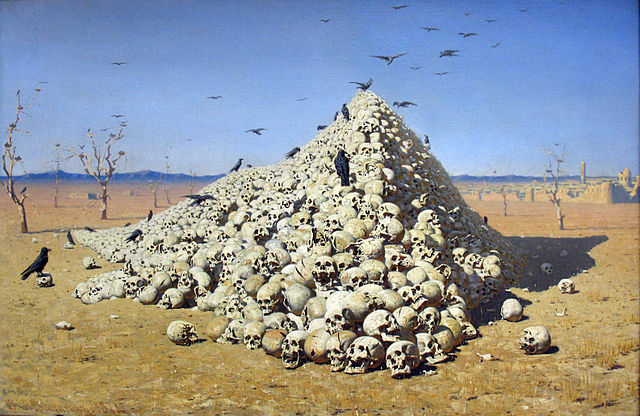
A painting that literally speaks silence. Skulls piled in the middle of nowhere. Nature taking care of whatever flesh is left through its scavengers. Vasily travelled a lot around the world and his other paintings are similarly realistic, silent, time-stopping and profound.